


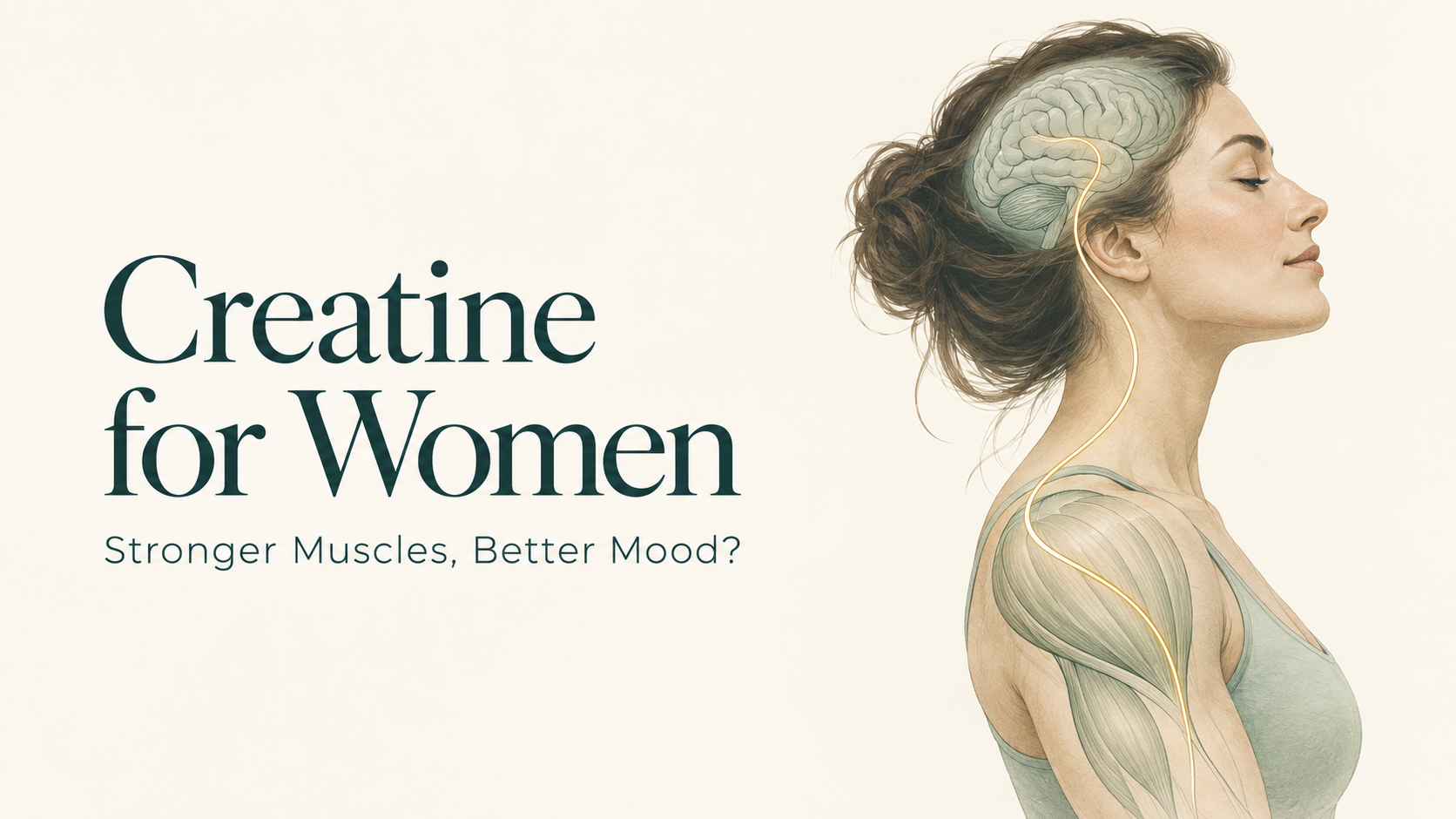
Creatine often brings weightlifting to mind, yet its role extends beyond the gym. Muscles and the brain both need a steady supply of energy. Creatine helps cells meet that demand, raising meaningful questions about strength, mental fatigue, and depression in women.
The evidence varies by goal. Creatine can support muscle performance, particularly alongside resistance training. Early studies also suggest benefits when combined with depression treatment. However, researchers have not established that every woman needs it or that higher doses reliably improve brain function.
How Creatine Connects Muscle and Brain Energy
Your body makes creatine, and foods such as meat and fish supply additional amounts. Cells use creatine and phosphocreatine to help replenish ATP, their immediate energy source. Think of this system as a rechargeable energy reserve that helps bridge sudden increases in demand.
Supporting cellular energy may help both tissues under strain, although a plausible mechanism alone cannot establish a clinical benefit.
Why Creatine May Be Useful for Women
Creatine can help women perform repeated, demanding muscle contractions and gain strength with training. Maintaining muscle supports mobility as women age.
Hormones such as estrogen may influence how the body produces and uses creatine. Researchers are studying these relationships across the menstrual cycle and menopause, but lower estrogen alone does not establish a creatine deficiency or predict who will benefit most from supplementation.
Diet also matters. Vegetarian and vegan diets often mean lower muscle creatine stores, leaving more room for an increase with supplementation. However, this does not reliably predict a larger cognitive benefit.
Still, results vary. A two-year trial involving 237 postmenopausal women found that creatine plus exercise improved walking performance and some measures of bone geometry, but did not improve bone density or muscle strength more than exercise alone. Creatine therefore complements a broader plan; it does not replace resistance training or osteoporosis treatment.
Early weight gain can reflect increased body water, including water within muscle cells, rather than fat. Abdominal bloating is a separate symptom and may signal digestive intolerance.
Creatine With SSRIs or Similar Medications
One notable eight-week trial enrolled 52 women with major depression. Researchers started escitalopram, an SSRI, alongside either creatine or placebo. Participants took 3 grams of creatine daily during the first week, followed by 5 grams daily.
The creatine group showed greater improvement in depression scores beginning at week two. The advantage persisted through week eight, without a significant difference in overall reported adverse events. However, this small study could not establish long-term effectiveness or detect uncommon risks.
The distinction between medications also matters. These findings do not establish equivalent benefits with sertraline, fluoxetine, SNRIs such as duloxetine, or other antidepressants such as bupropion. Nor do they prove that creatine treats medication-related fatigue, sexual side effects, or emotional blunting.
For a woman with persistent depression, creatine may warrant discussion with her prescribing clinician as an additional treatment. It should not prompt an unsupervised antidepressant reduction.
What About Women Who Do Not Take Antidepressants?
Muscle benefits do not depend on antidepressant use. A woman can consider creatine for strength and exercise goals regardless of whether she takes psychiatric medication.
Mood research also extends beyond medication. A 2025 pilot trial enrolled 100 adults with depression, including 50 women. Adding creatine to cognitive behavioral therapy improved depression scores more than adding placebo over eight weeks. However, 40% of participants in each group discontinued treatment, limiting confidence in the findings. The study does not establish creatine alone as a depression treatment.
For women without depression, consistent everyday benefits for mood, memory, or concentration remain uncertain.
| Goal | What the evidence supports | Main limitation |
|---|---|---|
| Strength and exercise | Benefits alongside resistance training | Responses vary |
| Depression with an SSRI | Promising results with escitalopram | Small, short trial |
| Depression without antidepressants | Promising addition to psychotherapy | Not proof of benefit alone |
| Everyday cognition | Mixed findings | No reliable benefit for everyone |
| Menopausal bone health | Some encouraging structural findings | No established osteoporosis treatment role |
Do Higher Doses Reach the Brain More Effectively?
Creatine can cross the blood-brain barrier through a specialized transporter called SLC6A8. However, the brain regulates entry and also makes its own creatine. Its uptake differs from muscle uptake.
Imagine a controlled gateway. Increasing the supply outside may help, but it does not necessarily widen the gate or double the amount entering. More creatine in the bloodstream does not automatically mean proportionally more in the brain—or better thinking.
What High-Dose Studies Actually Show
A 2024 crossover trial involving 15 adults found that a single dose of 0.35 grams per kilogram improved selected cognitive outcomes during sleep deprivation and altered brain energy measurements. For someone weighing 70 kilograms, that equals 24.5 grams.
A 2026 study involving 29 adults found benefits during sleep deprivation at 0.2 grams per kilogram, or 14 grams for the same body weight. Women appeared to benefit more on some tasks, but the small subgroup warrants caution. This study measured cognitive performance, not brain uptake.
These experiments suggest that larger doses can help under specific conditions, but they did not directly compare the two doses within one trial. They do not establish an optimal daily dose, prove greater blood-brain barrier transport at each higher dose, or justify replacing sleep with supplementation.
Conversely, a six-week trial of 10 or 20 grams daily in healthy young adults found no significant cognitive benefit. Dose selection should follow the person’s goals and response.
Choosing a Practical Dose
Creatine monohydrate has the strongest research foundation. For many healthy adults pursuing muscle benefits, 3–5 grams daily offers a practical starting range. Without an optional loading phase, muscle stores generally build toward saturation over about 3–4 weeks. Brain responses vary more, and researchers have not established a reliable saturation timeline or guaranteed cognitive benefit from longer use.
| Approach | Purpose | Perspective |
|---|---|---|
| 3–5 grams daily | Gradual muscle saturation and maintenance | Common practical approach |
| About 20 grams daily in four 5-gram doses for 5–7 days | Faster muscle loading | Optional; may increase digestive symptoms |
| Higher doses for brain or mood goals | Experimental or individualized use | No established routine target |
Digestive tolerance also matters. Larger single doses may cause diarrhea; persistent bloating or other digestive symptoms warrant reducing or stopping the supplement and discussing them with your clinician.
Kidney disease requires individualized review. Creatine can also increase blood creatinine without necessarily indicating kidney injury, so tell your clinician before interpreting laboratory changes. Pregnancy and breastfeeding lack sufficient supplementation safety evidence. A history of bipolar disorder deserves particular caution because small studies have reported hypomania or mania.
How This Applies to Different Women
These examples illustrate decisions rather than actual patient outcomes.
- Case 1 — Strength After Menopause: A 58-year-old woman starts resistance training. Creatine may complement her program, while adequate nutrition and progressive exercise remain central.
- Case 2 — Depression Despite an SSRI: A 36-year-old woman taking escitalopram asks about creatine. Her prescriber reviews symptoms and discusses the limited evidence before considering an additional treatment.
- Case 3 — Brain Fog Without Medication: A 43-year-old woman wants 20 grams daily for concentration. Her evaluation first considers sleep, iron deficiency, thyroid function, and mood rather than assuming she needs a higher dose.
Why Holistic, Individualized Care Matters
Strength, sleep, mood, nutrition, and hormonal changes influence one another. An endocrinologist can help assess metabolic contributors to fatigue while coordinating with mental health clinicians when depression plays a role. Creatine works best within a plan that identifies the actual problem and tracks meaningful improvement.
The Takeaway
Creatine offers credible muscle benefits and promising additional support for depression treatment. Brain research continues to develop, but current evidence does not establish that higher daily doses consistently deliver greater benefits.
At our practice in Montgomery County, Maryland, and through virtual care, we help women connect muscle health, metabolism, sleep, and emotional well-being through personalized care. Together, we consider whether creatine fits your goals and how to assess its value within your broader treatment plan.

References:
- Long-term creatine intake is beneficial to muscle performance during resistance training. Vandenberghe K, et al. Journal of Applied Physiology. 1997.
- A 2-year randomized controlled trial on creatine supplementation during exercise for postmenopausal bone health. Chilibeck PD, et al. Medicine & Science in Sports & Exercise. 2023.
- Creatine augmentation of an SSRI in women with major depressive disorder. Lyoo IK, et al. American Journal of Psychiatry. 2012.
- Creatine added to cognitive behavioral therapy for depression. Sherpa NN, et al. European Neuropsychopharmacology. 2025.
- Single dose creatine improves cognitive performance and induces changes in cerebral high energy phosphates during sleep deprivation. Gordji-Nejad A, et al. Scientific Reports. 2024.
- Single-Dose Creatine Reduces Sleep Deprivation-Induced Deterioration in Cognitive Performance. Gordji-Nejad A, et al. Nutrients. 2026.
- Dose–response of creatine supplementation on cognitive function in healthy young adults. Moriarty T, et al. Brain Sciences. 2023.
- International Society of Sports Nutrition position stand: safety and efficacy of creatine supplementation in exercise, sport, and medicine. Kreider RB, et al. Journal of the International Society of Sports Nutrition. 2017.
- Creatine as adjunctive treatment for bipolar depression. Toniolo RA, et al. Journal of Neural Transmission. 2018.
- Gastrointestinal distress after creatine supplementation in athletes: are side effects dose dependent?. Ostojic SM, Ahmetovic Z. Research in Sports Medicine. 2008.
- Effect of creatine and weight training on muscle creatine and performance in vegetarians. Burke DG, et al. Medicine & Science in Sports & Exercise. 2003.
- The effects of creatine supplementation on cognitive performance—a randomised controlled study. Sandkühler JF, et al. BMC Medicine. 2023.
- Creatine in women’s health: bridging the gap from menstruation through pregnancy to menopause. Smith-Ryan AE, et al. Journal of the International Society of Sports Nutrition. 2025.
About Dr. Gerti Tashko, MD
Dr. Gerti Tashko, MD, is an endocrinologist in Montgomery County, Maryland. He is uniquely quadruple board-certified in endocrinology, lipidology, hypertension, and obesity medicine. His practice delivers root-cause-focused metabolic and endocrine care, available virtually and in person. He uses advanced diagnostics, personalized nutrition, and preventive medicine to improve long-term health.
